Choosing smartly between frequently asked and local questions to Gem
Some questions come back every day. Think of: "When can I collect my passport?" or "How do I request an extract from the personal records database?" Getting the answer right matters, because will the resident turn up at the desk with the right documents? Almost every municipality receives these common questions. Within Gem we call these short-tail questions. Gem then gives answers that have already been checked by municipal staff. These answers are reliable and consistent.
Other questions come up less often and need a tailored response. Think of a building project, a road closure, or a development in a neighbourhood. We call these long-tail questions. For now, Gem still refers residents to a web page for these questions. But before long Gem will be able to answer them using generative AI. Gem then searches municipal sources, retrieves up-to-date information and puts together a fitting answer. Is the right information missing? Then Gem passes the resident on to a member of staff.
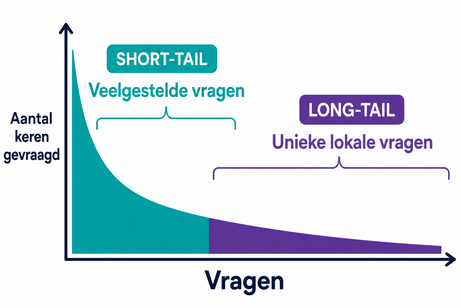
A small number of frequently asked questions make up a large share of all conversations (short tail). There is also a long series of unique, local questions (long tail).
Gem uses the best of both worlds by combining pre-checked answers with generative AI. Municipalities work together on answers that apply to all municipalities, while keeping room to add local information and provide a tailored response. And municipalities themselves will decide which type of answer suits which question: pre-checked, or generated with generative AI.
Looking back on the conference
Yesterday we attended the ‘Samen Versnellen met AI’ (Accelerating Together with AI) conference in Hilversum. There we talked with visitors about Gem and the AI applications we are developing for government organisations.