Sovereignty and language models

The sovereignty of Gem, layer by layer
When organisations keep control of their own data, infrastructure and management, within applicable Dutch laws and regulations, you can call that sovereign.
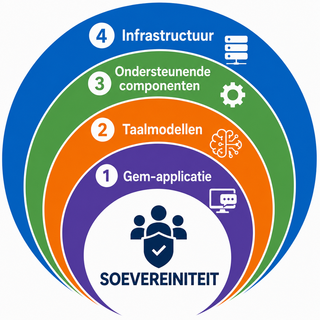
For Gem we look at four layers of sovereignty:
- Layer one is the Gem application itself. Technical management and further development sit with the Gem development team. That places it under Dutch government control.
- Layer two is about the language models and marks the transition from Gem 1.0 to Gem 2.0. ICTU offers several language models, running from most to least sovereign: - Layer 2a is GPT-NL: a Dutch language model trained on lawfully obtained Dutch data and running on our own Dutch infrastructure. - Layer 2b covers open source language models trained on data that may or may not have been obtained publicly, and running on our own Dutch infrastructure, such as at ICTU, or like Vlam AI, which runs in the government data centre in Rijswijk. - Layer 2C consists of public cloud models such as Azure and AWS. They are trained on publicly obtained data and run on foreign infrastructure. These models are not fully sovereign, but they do comply with Dutch laws and regulations through SLM Rijk.
- Layer three consists of supporting components such as logging and monitoring. These components come from the standard platform provided by Logius and are managed by the Dutch central government. That makes this layer sovereign by design.
- Layer four is the infrastructure. Gem currently runs in ICTU's test environment, in a central government data centre (ODC-Noord). A Dutch data centre, under Dutch control. This layer is therefore sovereign as well.
Which language model level (layer 2) is best for Gem is something we are investigating in AI-land through exams and practical research.